

Size

Build: 9,500 sq. ft.
Units: 40 interior stalls

Year

In Progress

Client

Pepper Place Market

Caitlin Taylor, RA

Caitlin Taylor, RA

Design Director

Caitlin joined MASS in 2018 as an architect with a background in food and farming; she brings to the firm an interdisciplinary focus on environmental, economic, and social justice in the food system. She directs the Food System Design Lab at MASS, and is leading projects around the country including the Stone Barns Center for Food & Agriculture, the Poughkeepsie Public Market, and the Pepper Place Pavilion.

Caitlin lives with her family in East Haddam, Connecticut, where they own and operate an organic vegetable and cut flower farm. She has taught advanced architecture studios at the Yale School of Architecture, Columbia GSAPP, and Cornell AAP, and previously worked at firms in New York City and Connecticut.

Her previous work on urban flood control in Las Vegas was awarded the Holcim Foundation for Sustainable Construction Gold Prize. Caitlin studied biochemistry at Wesleyan University and received her Masters of Architecture from Yale School of Architecture, where she received the Henry Adams Medal. She is a registered architect with licenses in Connecticut and Massachusetts.

Project Team

Caitlin Taylor, Vrinda Sharma, Elena Baranes

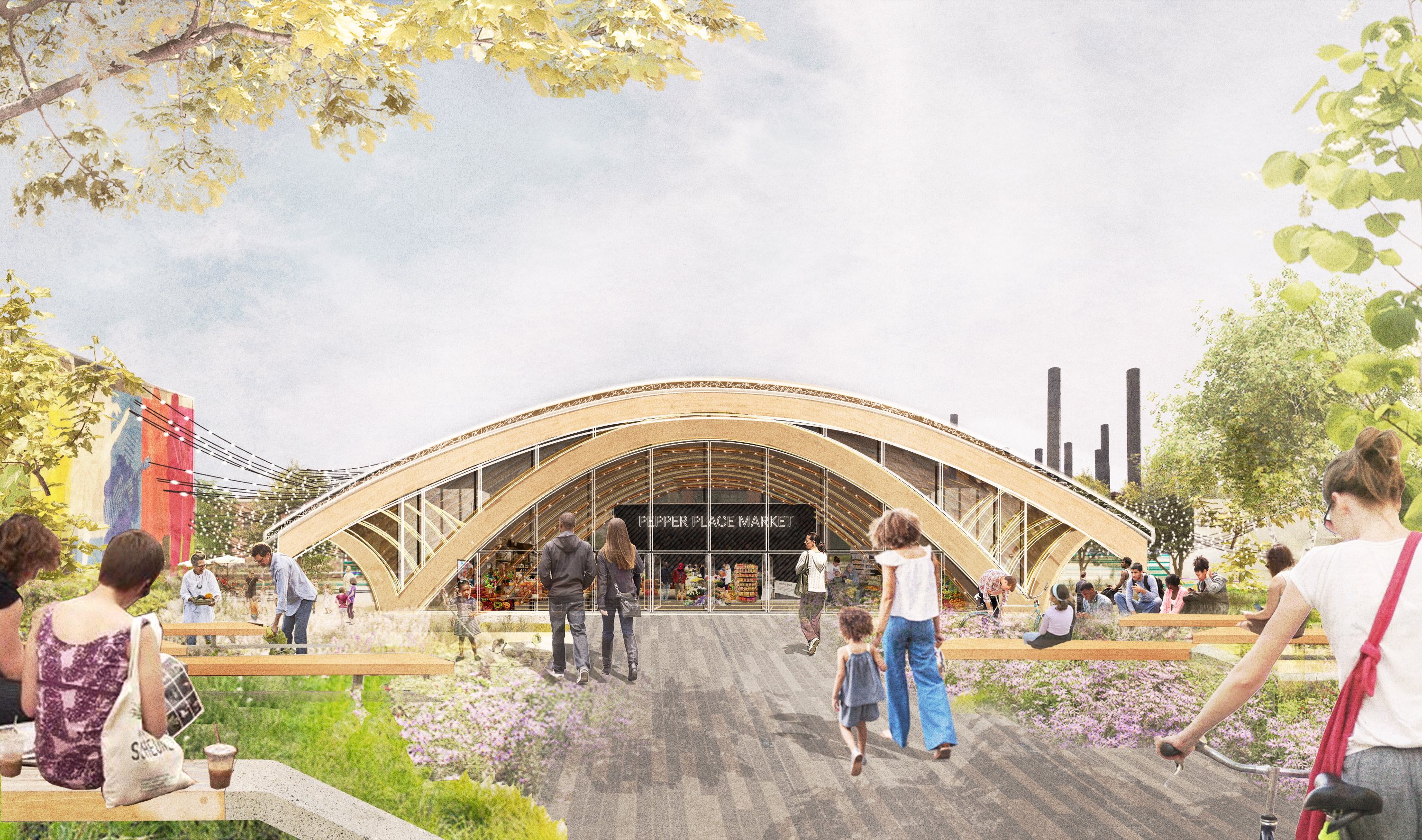
Committed to equitable food access, Pepper Place Market in Birmingham, Alabama, supports more than 100 local producers, serving approximately 10,000 shoppers each week. MASS Design Group engaged with the market on a collaborative design process to help create a pocket park anchored by an open-air market pavilion, connected to an existing trail system.

By producing permanent market infrastructure including an operational kitchen, the new pavilion will ensure year-round programming and orient future development around a center of gravity in a key city location.

The central pavilion features tiles and wooden beams locally sourced and fabricated by local business, echoing the thoughtful consideration of ingredients of the “slow food” principles that the market espouses.

Glass walls and bifold doors create a transparent enclosure to the market’s interior, allowing the facility to operate year-round.

Adjacent to the core pavilion are outdoor community gardens to help encourage residents to participate in the growth and distribution of Birmingham’s food systems, as well as additional vendor space for the summer months.

Read more about Pepper Place Market in ARCHITECT Magazine.