
Size

Site: 900,000 sq. ft.

Year

In Progress

Client

The Mayor’s Working Group on Homelessness and Addiction at the Intersection of Massachusetts Ave & Melnea Cass Blvd, The Boston Architectural College, Rhode Island School of Design

Partners

The Mayor’s Working Group on Homelessness and Addiction at the Intersection of Massachusetts Ave & Melnea Cass Blvd, The Boston Architectural College, Rhode Island School of Design

Patricia Gruits, RA, LEED AP

Patricia Gruits, RA, LEED AP

Senior Principal & Managing Director — Boston

"I believe that the built environment impacts our lives and we can design the process to create positive social change."

Patricia Gruits is a Senior Principal with MASS Design Group leading both design and research projects in health, education, and equity. Since joining MASS in 2013, she has led the design of the Maternity Waiting Village in Malawi with the Malawi Ministry of Health, the African Leadership University, a series of primary schools in East Africa with the African Wildlife Foundation and the MSquared Foundation, and the development the Ellen DeGeneres Campus of the Dian Fossey Gorilla Fund.

Currently, Patricia leads design and research initiatives at MASS with a focus on planning, design, and evaluation. Her work is aimed at engaging and empowering stakeholders in the design process; supporting and substantiating the impact of design on health, social, and environmental outcomes; and translating research into design strategies and decision-making. She has coordinated the creation of the Purpose Built series— a set of tools for creating impact-driven design— and has implemented this approach in the design of affordable housing, healthcare, and urban design projects around the globe. Patricia has also managed a range of design projects aimed at proving the impact of the built environment on individual and community health in the United States, including a collaboration with the mayor’s working group to address issues of homelessness, addiction and recovery in Boston and partnered with community development corporations to create affordable and supportive housing.

Patricia collaborated with the Joint Center of Housing Studies at Harvard to create guidelines for Safe Interaction in Senior Affordable Housing in response to COVID-19, and has lectured at the Harvard School of Public Health as a part of the USAID sponsored Airborne Infection Control course. She has taught design studios focusing on social impact at the Boston Architectural College and RISD. Her work has been published in journals of architecture and health and was recently awarded the “Top 40 under 40” for Sustainable Design by Impact Design Hub.

Homelessness and opioid addiction are national challenges faced by many cities in the US. In Massachusetts, the state with the 7th highest rate of homelessness in the nation, deaths from opioid overdose tripled between 2013 and 2017.

An increasing number of residents from across the state seek treatment in Boston, the leading city for recovery services in the region. Historically, a dozen social service organizations have been located along the Massachusetts Avenue Corridor - running between the South End and Roxbury neighborhoods through the industrial Newmarket District. The closing of Boston’s “Long Island Shelter” in 2014 placed further demand on services in this area, contributing to a rise of homelessness and opioid use on the streets and causing the area to receive the negative moniker of “Methadone Mile.”

As the neighborhood intersection develops, inadequate urban planning and rising real estate values are leading to widespread gentrification, heightening tensions between residents, patients, local businesses, service providers, law enforcement, and local government departments. In Fall 2016 Mayor Walsh responded by establishing a Working Group on the Issues of Homelessness and Addiction at Massachusetts Ave and Melnea Cass Blvd bringing together a range of stakeholders to address these issues.

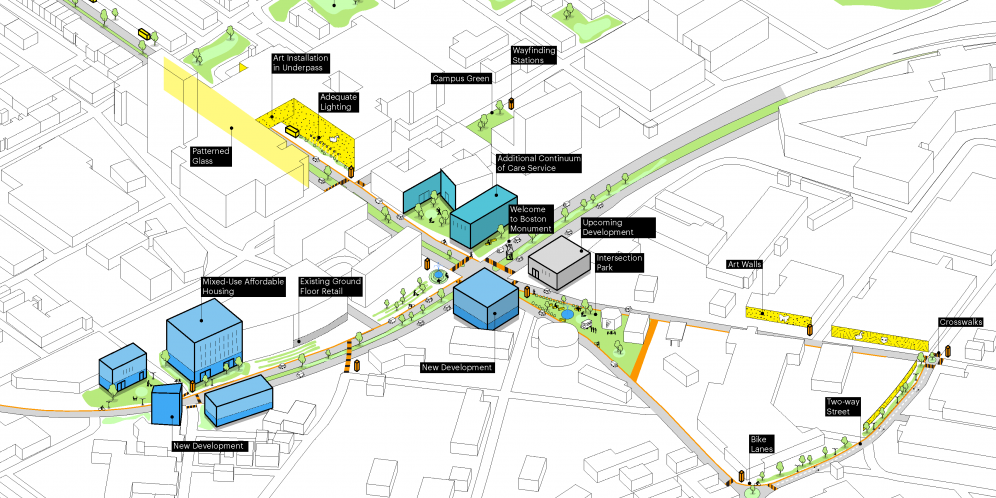
After attending Working Group meetings, MASS Design Group established a collaboration with the Boston Architectural College and the Rhode Island School of Design to explore how design can contribute to the short and long term solutions to these public health issues. This collaboration brought together architects, landscape architects, and industrial designers to conduct interdisciplinary research, analysis of the urban conditions, and community engagement, to develop holistic and inclusive design solutions to the issues at Massachusetts Ave and Melnea Cass Blvd.

The project resulted in rich data visualization, film documentation, and a master plan strategy for the corridor that will address gaps in facilities and services for those seeking support for addition or homelessness as well as create a just and equitable Boston for all. This master plan was presented to the Working Group for feedback in summer 2017. The project’s next steps are to identify priorities and key partnerships to move forward with implementation.